Work items & pipelines
Briefs move from draft to ready, running, review and done. Each run gets its own git worktree and flows through phases (agent, check, judge, pause, action) defined as reusable pipeline templates.
local · container · cluster
continuous software evolution · self-hosted
aifold is an autonomous AI software factory that connects the dots: it builds, operates, maintains and continuously evolves your software in one unbroken line. Coding agents do the work, code checks each step, and you decide what ships.
Not a one-off generator. A schedule, a merge, a new brief or a change of mind starts the next run: investigated, implemented, checked by code and waiting for your review. Then it does it again.
schedule 07:00 daily opened a work item in aifold
06:59:58 trigger morning-improvement fired · budget $2.00 per phasebrief tighten flaky retry in the ingest tailerEdit src/AiFold.Core/Tailing/Tailer.csgate tests_kept ✓ changed_files ✓ stays_in_lane ✓judge reading the attempt…
how it works
Traditional development is project-shaped: a kickoff, a delivery, a handover. aifold is persistent. It doesn't turn one idea into one release. It keeps a loop running around your software for as long as the software exists.
A written brief becomes a run: a coding agent in its own git worktree, working through a pipeline of phases, on a budget its CLI enforces.
Your checks run in a sandbox with no network. Gates written in code decide whether a phase passed, not the agent's own opinion. A judge weighs the result before you do.
Every transcript line lands in Postgres and streams live. Cost, context use and how much of the agent's code survives afterwards are measured, not guessed.
What was learned goes into the knowledge base and into the next brief. Triggers open the next work item. Then it goes round again.
signals
Time, people, merges, tickets, telemetry, dependencies. Each is a trigger: an event source, a condition and an action. Some are running today; the rest are designed and on the way.
Write a brief, pick a pipeline, hand it to an agent. The product evolves with you, not in big-bang projects.
A standing job opens its own work item on a schedule, in your timezone, and has a branch waiting in review.
A signed webhook closes the work item when its branch merges, and survival tracking starts watching the code.
Tickets from GitHub, Linear or Jira become work items, and the result is written back to the ticket.
An alert carries its telemetry into a brief, so the agent starts from evidence rather than a guess.
Security advisories and new releases turn into maintenance work: upgraded, tested and gated like any other change.
review
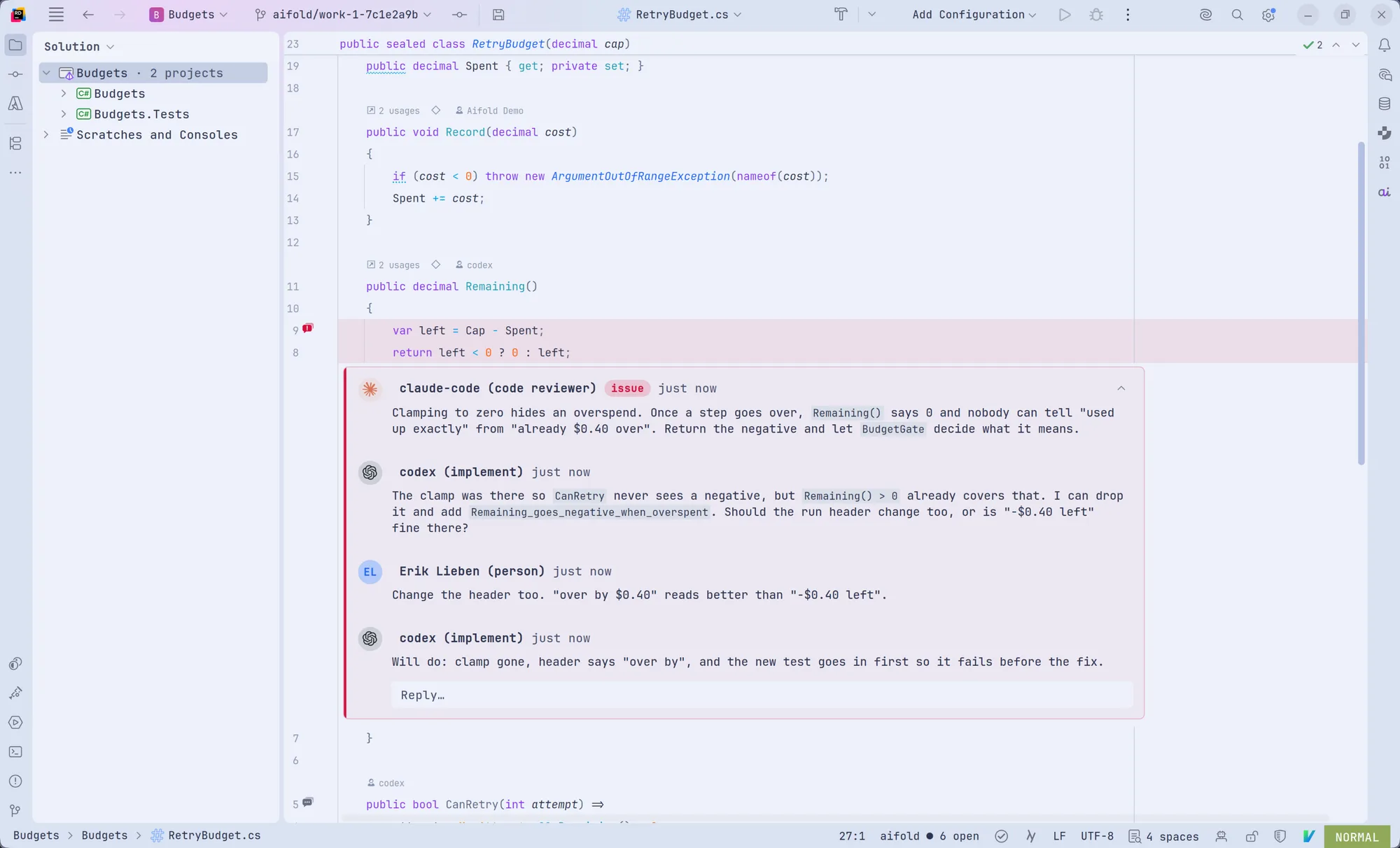
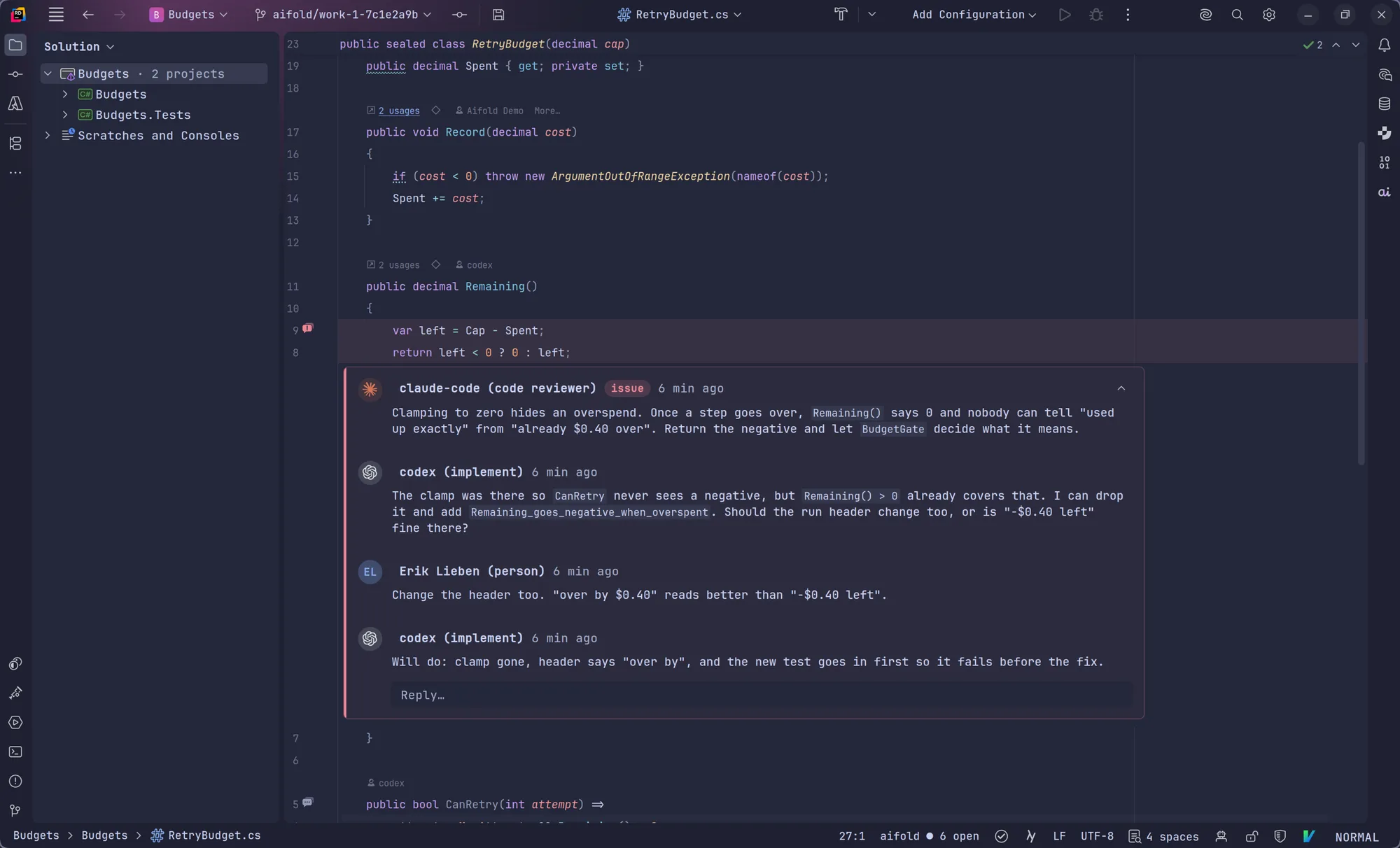
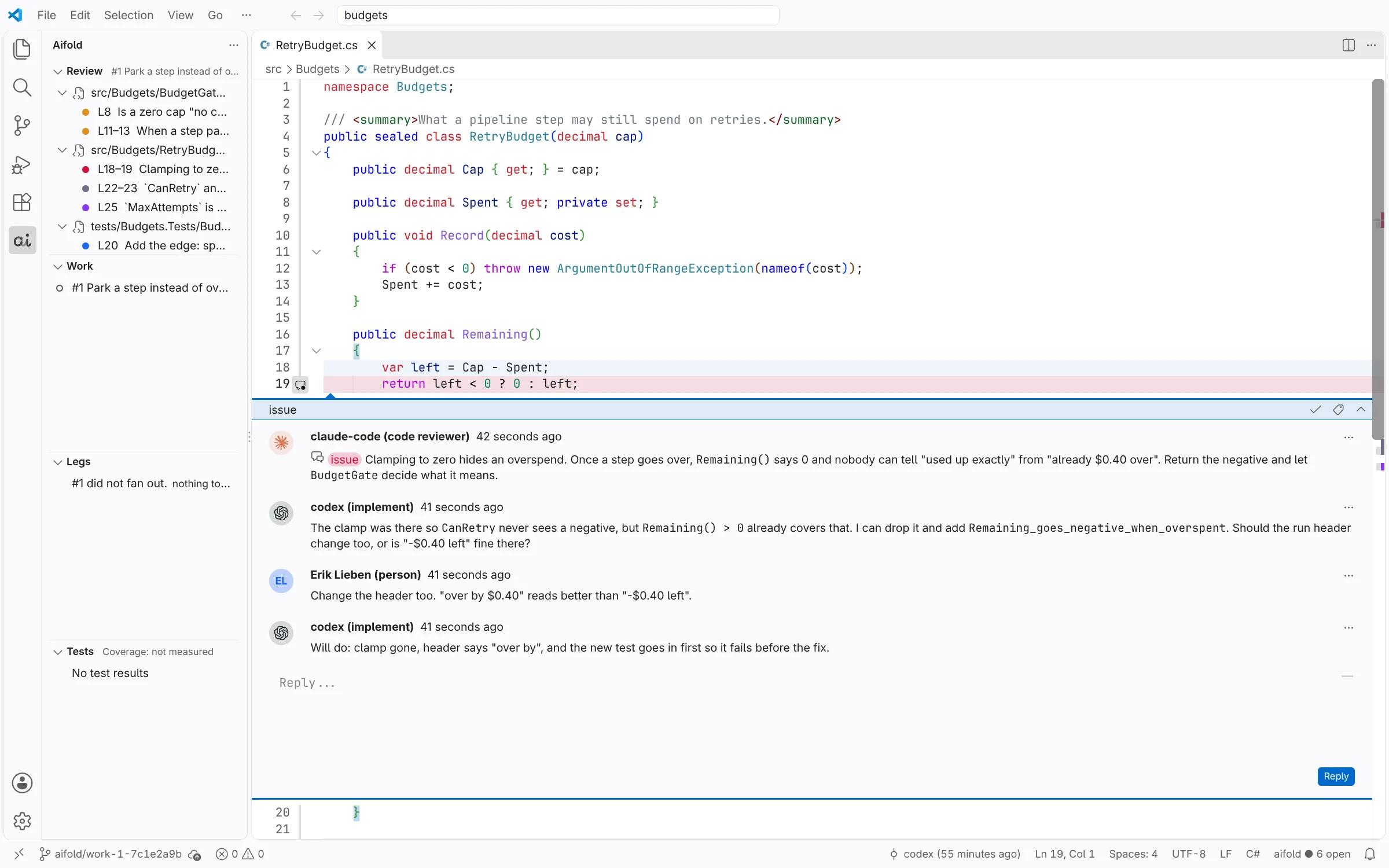
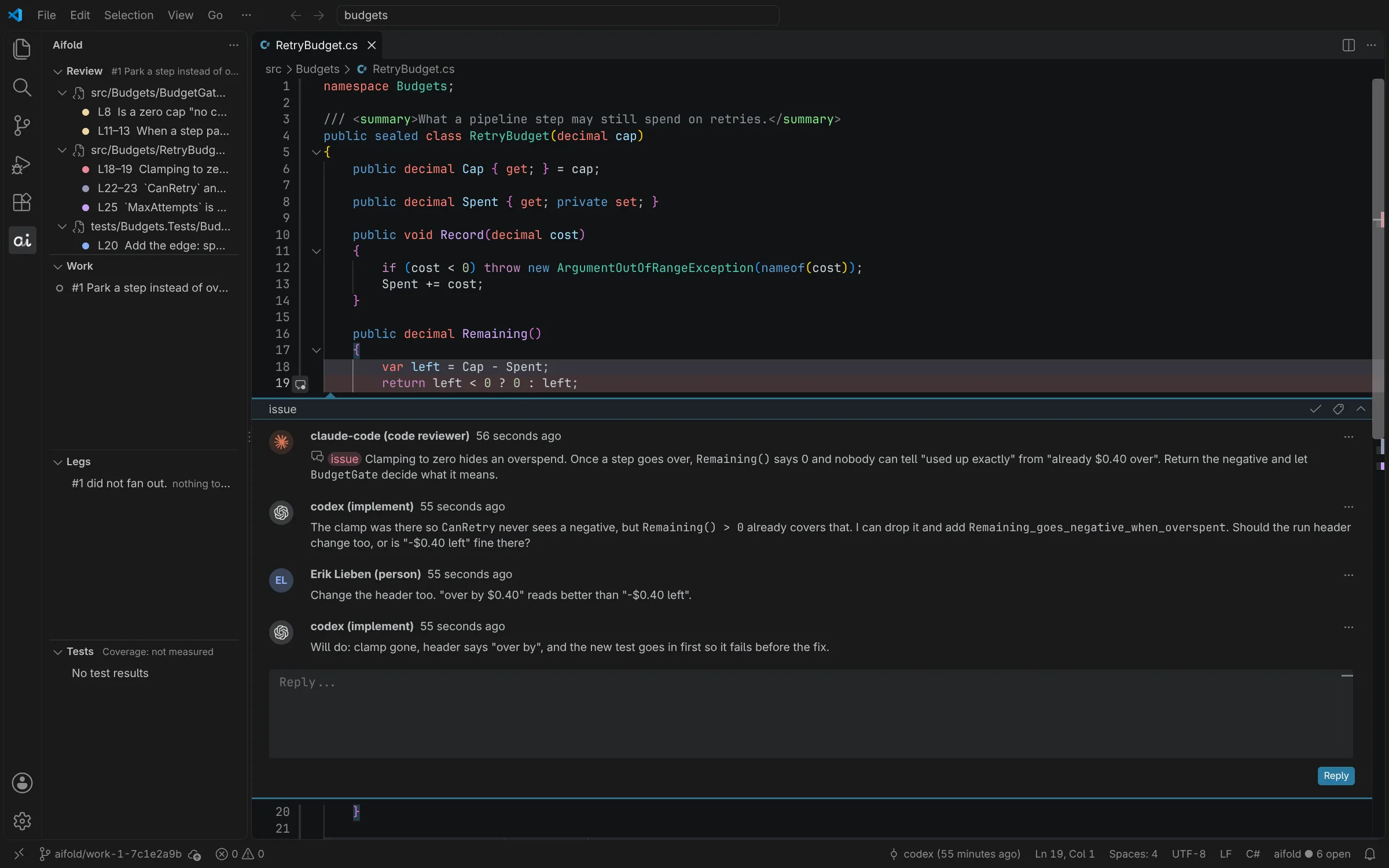
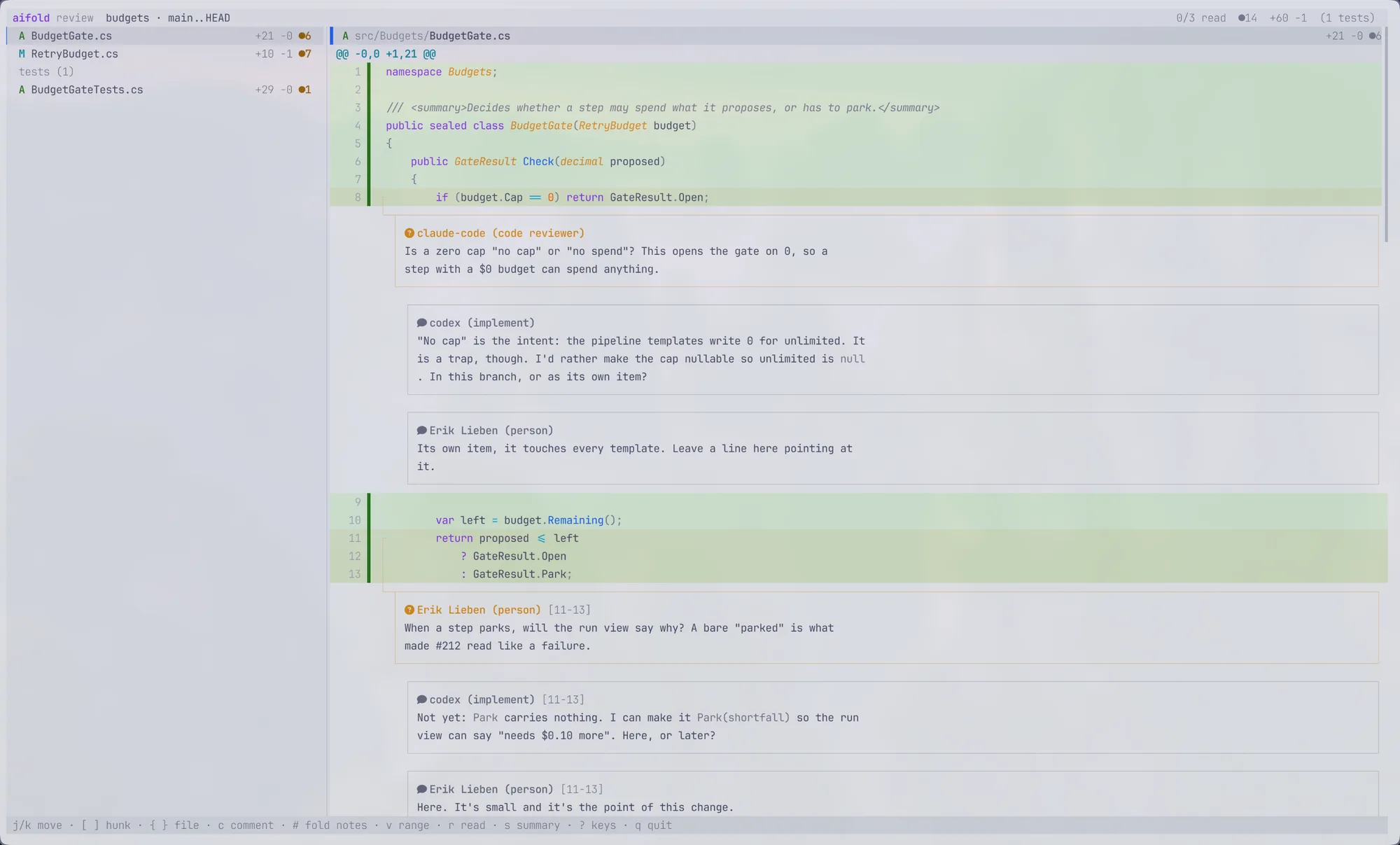
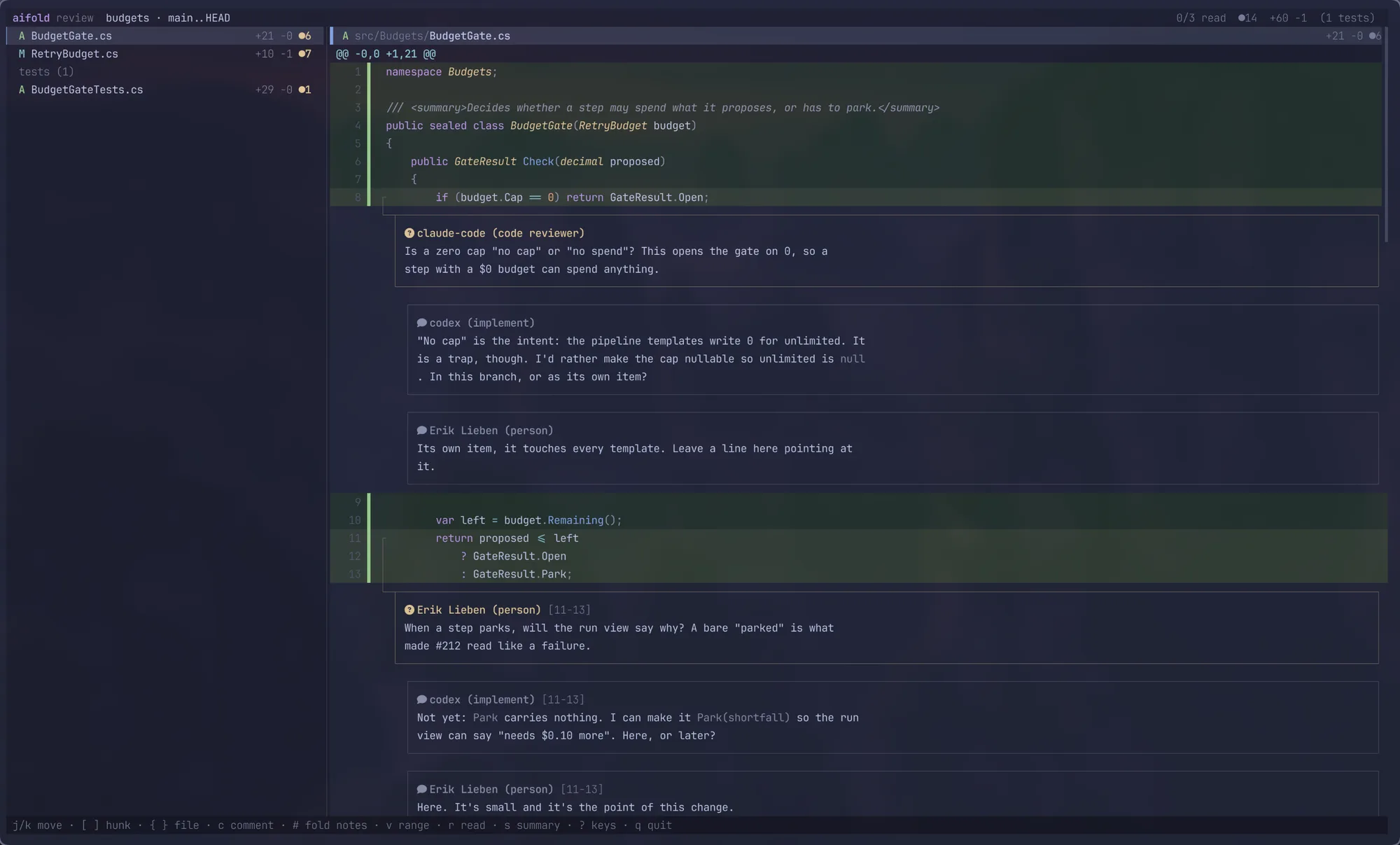
Every run stops at review. Read the change, leave notes on the lines they're about, and hand the open ones back to the agent. The same review and the same notes, in the editor you already have open.
The whole change as one diff, with viewed ticks per file and which changed lines your tests actually ran.
An issue, question, nitpick, todo or praise, pinned to the code's text so it stays put when lines move.
Hand the open notes to an agent. It answers or fixes, the checks run again, and you resolve what's settled.
Your software is never finished. Neither is aifold.
Agents are fast. What they lack is a place to work: a brief, a budget, a boundary, a record, and someone with taste at the end. aifold is that place, running at machine scale with your taste and your control.
features
Each piece is small and inspectable. Together they turn coding agents from a chat window into a production line you can trust.
Briefs move from draft to ready, running, review and done. Each run gets its own git worktree and flows through phases (agent, check, judge, pause, action) defined as reusable pipeline templates.
local · container · cluster
Code decides whether a phase passed: tests kept, criteria covered, lines covered, mutants killed, stayed in its lane. A failing gate resumes the same session and says exactly what was wrong.
tests_kept · mutants_killed · stays_in_lane
Each repository's own validation runs in a container with no network. A separate judge weighs surviving mutants and adds its verdict to the pull request. A finished run always stops at review.
podman --network none
aifold tails the transcripts agent CLIs already write, stores every line in Postgres and streams it to the browser as it happens: timeline, transcript, per-file changes and full-text search.
Claude Code · Codex · Copilot · SSE
Every event is priced at the rate in force when it ran, split into input, output and cache. Cost per commit, per thousand surviving lines, and the rework tax of work that wasn't accepted first time.
budgets enforced per run
Every file an agent wrote is re-scanned on a schedule. Drift and authored-line survival show how much of its work is still there weeks later, even after the code moved.
no git required
Versioned markdown pages, tagged and grouped, with a graph view and a search API agents call themselves. Short repository facts are added to every brief automatically.
/api/kb/search · repo_facts
Features, their acceptance criteria and the tests that prove each one, recorded as the work happens, so the documentation is a by-product of delivery, not a chore after it.
criteria_traced · criteria_covered
A 7.5 MB terminal review tool with one continuous diff and vim keys, plus VS Code and Rider extensions that put review notes on the lines they're about.
TUI · VS Code · Rider
An event source, a condition and an action. Schedules open standing work; merge webhooks close it. Every trigger has a spend cap and a limit on how much it may have open at once.
schedule · webhook · caps
Plan here, execute there. Agents create work items, read the feature map, start the real application and drive its UI through aifold's MCP tools.
create_work_item · start_runtime · drive_ui
Built on its own design system (Catppuccin Latte and Macchiato, three text sizes) and held to WCAG 2.2 AA in both themes, down to 320px.
WCAG 2.2 AA · light & dark
software, unfolded
Point it at your repositories and let the loop start turning.